(To listen to the audio of this blog post, use the purple play button.)
The Asylum
by Jim Potter

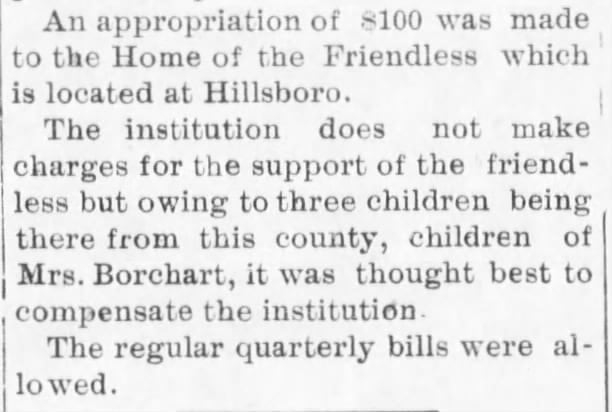
Anna Borchart’s fall from grace after the death of Richard, her husband, was reviewed in the February 16, 1900, issue of the McPherson Weekly Republican newspaper. The article, titled “Adjudged Insane,” read like an obituary as it noted the decision of the probate court.
“Mrs. Borchart brooded over her husband’s death until she lost her reason. She was at the poor farm for some time and was then sent to the Mennonite orphans’ home at Hillsboro. She kept getting worse and it became necessary to have her sent to the asylum. She has three children who are now at the orphans’ home at Hillsboro.”
*
There’s no reason to believe that Anna was adjudged insane solely due to her lack of financial resources, but people, especially women, were more likely to be judged lunatics when they were poor. Also, immigrants who didn’t understand English were, at times, deemed insane when the cause was simply a failure to communicate.
When the accumulation of stress on Anna helped cause her breakdown, she was sent to the Topeka Insane Asylum just three months after arriving at the McPherson County poor farm. In an era before the terms post-partum depression or schizophrenia existed as disorders, people were said to have become a maniac, become unmanageable, or gone mad.
I recognize that if I had been destitute and a single parent with three children, ages four and under, I might have joined Anna in the asylum.


As with poor houses, insane asylums were often judged as a way of protecting the vulnerable. When asylums were built, they were seen as a humane alternative to being incarcerated with violent offenders, and safer than being left on the streets where they could be preyed upon by criminals who would seek to exploit them. Conversely, others saw insane asylums as a place to warehouse troubled people. Out of sight was out of mind.
Treatment of people with mental illness is much better today, but when they’re emotionally disturbed and display socially unacceptable behavior, citizens still expect authorities to respond and to act.
Prior to dependable therapies and modern drugs, a display of “madness” (mental illness) was commonly believed to be untreatable. Sadly, many people confined to insane asylums became victims of doctors experimenting with harmful, even deadly treatments. Also, some patients had to endure years of abusive treatment at the hands of sadistic staff. If an inmate complained, she was more likely to receive a beating, not help.
There’s little chance of ever learning how Anna was treated at the Topeka Insane Asylum, but across the country, conditions at the institutions were often harsh, cruel, and inhumane. There were reports of patients being abused, neglected, and raped. I wonder if Anna was one of the residents who was confined or chained for long periods of time.
It’s difficult to imagine the terror that individuals endured in state run insane asylums, versus private asylums. Each day was often followed by a darker night.
*
One of the best investigative journalists ever—male or female—was American born Elizabeth Cochrane Seaman (1864-1922), better known by her pen name Nellie Bly.
In 1887, at age 23, after feigning insanity and having herself committed, she wrote an exposé about the negligence and terror of a New York City insane asylum.
Bly wrote: “Take a perfectly sane and healthy woman shut her up and make her sit from 6 a.m. to 8 p.m. on straight-back benches, do not allow her to talk or move during these hours . . . give her bad food and harsh treatment, and see how long it will take to make her insane. Two months would make her a mental and physical wreck.” (The World, Oct. 9. 1887.)
*
One of the major criticisms of the asylum system, besides abuse, was the “institutionalization” of the patients. Those confined became so dependent on the institution providing for them that they had difficulty coping in the outside world even when their condition had long since improved.

The Topeka Insane Asylum was opened in 1879 due to overcrowding at Osawatomie’s State Insane Asylum.
The 1900 US Census recorded 1,036 men and 264 women inmates in Topeka’s Asylum. Together, the population was 1,300 people. As with any city of this size, the huge institution required a lot of employees for it to run efficiently. The Census listed thirty-three different occupations. Click this link to see the list: Occupations of Employees at Topeka State Asylum in 1900 Census
Of the women, 256 were white, eight black. The average age of the women was 43.17 years. One-hundred-eighty-eight were born in the US, representing twenty-one different states. The three states with the most births were Kansas, Illinois, and Indiana. Out of the same group of 264 women, seventy-six were born in a total of sixteen different countries. The top three countries, in order were Germany, Sweden, and England. Click the link to see the complete list. Kansas State Insane Asylum 1900 Census Women Place of Birth
*
I can only imagine Anna’s thoughts while being taken from the poor farm by law enforcement to the Topeka Insane Asylum. Not knowing if she would ever be free to see her children again must have been an immense burden. She would have heard of others who had been declared insane, who were incarcerated, but had eventually been cured and returned home.
Anna would have had questions, no answers. She might have repeatedly asked God, “Why did Richard have to die, leaving me to struggle?” With three children and no money, Anna must have felt overwhelmed and discouraged. When she worried about her boys, it only made her anxiety worse. In a lucid moment, she may have asked herself: “Will I ever be able to return to Inman, regain custody of my boys, and raise them? If I never return to Inman, how long will Arthur, Robert, and Willie live at the Mennonite orphanage? Will they be safe? God, if they are adopted, please help them be raised by a loving family.”
*


So vivid.
Thanks! Sad times.
Sad to read that so many women were just thrown into situations that would make almost anyone “insane.”
Fred, thanks for your comment. Out of sight, out of mind.
A touching and thought provoking story Jim. Your inclusions of compassion were appreciated.
Phil, thanks for your comment. I remember in school when the teachers told us to never use the word “I” in our writing assignments.
How sad it all was–beyond imagining. We still have too many reports of ill-treatment, but it’s the exception, I hope, rather than frequent.
Thank you for shedding the light on a difficult slice of KS history.
Marilyn
Yes, we’ve come a long way, yet we have so much further to go.
That Topeka Insane Asylum has such appealing structure based on the photo of the postcard. Very talented by whoever the designers and builders were. It has an inviting and pleasant look to it.
Another great story with attention to detail, Jim!
Thanks, Pat. You have a great eye. (No wonder you’re a great photographer!) John G. Haskell, the state architect, designed the Topeka Inasnes Asylum, but prior to that he designed the State Insane Asylum at Osawatomie, anothe imposing building.