
Dorothy Mackaill
By Jim Potter


A biography is non-fiction. The true stories told by biographers are written after diligent historical research. Like detectives, writers become so familiar with their characters, settings, and facts, that they are better prepared to predict the behavior of a person of interest when trying to solve a case.
This chapter focuses on famous movie actress Dorothy Mackaill, born in the parish of Sculcoates, Kingston upon Hull, Yorkshire County, England, in 1903. While I have no proof that Gladys Mary Gamble, also a Hull native, born in 1908, was a movie fan of Mackaill, I know that Gladys and her sisters acted in local stage productions. Gladys also enjoyed attending the cinema in Hull where silent movies starring Mackaill were especially popular with the home crowd.
Dorothy and Gladys may have never met in person since they were from different socio-economic classes, worlds apart, unless the two of them ran into one another while attending a Hull cinema prior to Dorothy moving to the United States where she became famous as a movie star. (I’m still trying to determine if the two Hullites could have attended the same primary or secondary school since geographically their families lived reasonably close to one another.)


As mentioned previously, even prior to Gladys’ father being killed in action during the World War, the Gamble family was a hard-working, lower-class family with six children. Dorothy’s parents, John and Florence, had two children, Dorothy and Harry, and lived in a well-off area of Hull called “The Dukeries” at 15 Newstead Street.1 John was the manager of the King Edward Street branch of the Maypole Dairy Company.2 As far as I can determine, he did not serve in the military.

Dorothy recalled that from the age of six she wanted to be a singer and dancer and would practice her routines in front of a mirror. With her parents, it’s easy to see how Dorothy was drawn to show business. Florence, a big fan of the theater, enjoyed attending the cinema with her daughter. As an adult, Dorothy recalled that all her professional achievements were done to win her mother’s approval.4 John wanted Dorothy to follow him into the family grocer business, but instead, his dancing studio exerted greater influence on her. She set her heart on the stage,5 not on selling butter or tea.
Dorothy was thirteen years old when her parents separated.3 Later, her father was given custody of both children when he divorced Florence.

At age fourteen, Dorothy, just like Gladys Gamble, ended her regular school education, but she received financial support from her father. Dorothy pursued her dream of a dancing career. Her father paid for her to attend a two-year program at the Thorne Dancing and Dramatic Academy in London where she learned dancing and elocution (that helped her soften her distinct Hull accent). Dorothy stayed nine months before departing, ready for the bright lights. Miss Madge Thorne, who trained Miss Mackaill for the stage at the academy, recalled Dorothy as the most self-possessed and confident pupil she ever instructed. Thorne added that Mackaill was resourcefull and courageous, as well as being extremely nice.6

At age sixteen, Mackaill had a small part in a British movie, The Face at the Window, and made her professional debut as a chorus girl in Joy Belles at London’s Hippodrome. At age seventeen she performed at the Ziegfeld Follies in Paris, and acted in a couple of short French films, before migrating to the United States at age eighteen to further her career as an actress. Mackaill arrived in New York City on June 16, 1920,7 and talked her way into the Ziegfeld Follies, dancing in the Midnight Review.

Dorothy was young, gorgeous, talented, and confident. Her attributes were helpful on and off stage. Besides her father paying tuition at the Thorne Academy, Dorothy recalled two times she received financial assistance from strangers.
While working in Paris, she set her sights on a career in the United States but didn’t have money for the transatlantic fare. Miraculously, she received a financial gift from a man who purchased her a one-way passenger ticket to New York City on the French liner SS Leopoldina.8
Upon arrival at the Manhattan docks with two of her chorus girl friends, her plans to stay with an aunt of one of the girls was unsuccessful. Without a credible person to vouch for Dorothy’s resources, she could have been refused entry to the country. Instead, as Dorothy, in tears, waited for a bureaucratic decision from the United States Inspection Service, another stranger saved her day. This man guaranteed to the authorities that Dorothy would not be a “public charge” (financial burden) to the country during her three months stay.9 After that, Dorothy was able to locate the house of her chorus girl friends. She was staying with them when she secured a job dancing in the Ziegfeld Follies, after boldly walking into the Ziegfeld offices announcing her arrival from Paris.
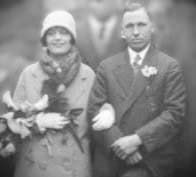
The biggest difference between a young Dorothy Mackaill and a young Gladys Gamble was social class, not beauty. Because of her father’s disposable income, Dorothy received lessons in dancing, elocution, and acting. Her professional training added to her self-confidence. Thanks to generous men, Mackaill had been gifted a passenger ticket to New York City, guaranteed financial stability while visiting the United States, and was hired on the spot to dance in a talented chorus line.
A few years later, Gladys also received help from men. Without a father or wealth, she gained self-assurance after being taught by her older sisters how to pick up sailors at the Hull docks who would lavish her with gifts for an evening. The young women enjoyed evening dates of free dancing or a movie.
By Gladys Gamble meeting Robert Parks, she received much more than enjoyable evenings of free dancing or movies. Like Dorothy Mackaill, Gladys found financial support to make her dream of moving to the United States come true.


Mackaill gained her personal freedom through strenuous chorus line work and acting. Her career as an actress was a meteoric success. By 1923, when the movie Mighty Lak a Rose was released to movie theaters, Mackaill starred in the leading role. Her salary was $1,000 a week.10
Mackaill had charisma and a contagious sense of humor. She was a versatile actress who appeared in several comedies and strong emotional dramas. Dorothy was more than talented; she had brains and beauty.
Once, when Dorothy was interviewed for a magazine article asking movie stars about their heroes, she answered, describing her kind of man. She said: “I am keen for the quiet, reserved man with character and a sweet temperament, who does things for a girl unobtrusively. Dependability is the first notch on my standard, and a man who can’t measure up at least that high needn’t call again. Reserve is second, and other attributes are strength of character and pleasing personality.”11
From what I know of the traits and character of Robert Parks, Mackaill’s description of her hero could have included Robert.

In the 1920s, called the “Jazz Age,” Europeans and Americans wanted to escape from the grim memories of the World War and other serious concerns. It was defined by a bold break from tradition, centered on themes of youthful rebellion, personal freedom, and modern consumerism. Going to the movies to watch lighthearted stories of adventure, comedy, and romance was an affordable escape. The silent picture shows, and later, the talking movies, became an influential force in shaping American culture and values, especially by helping spread new fads, fashion trends, and moral attitudes.
Movies helped influence young women to challenge the traditional beliefs about femininity. When women began cutting their hair short, in a style called “the bob,” the act was considered scandalous for making women look masculine. During this “flapper era,” the stylish rebellion included: replacing corsets with bras and lingerie, moveable fabric with a dropped waistline, sleeveless dresses, and knee length hemlines. With greater freedom, many women were seen drinking, smoking, partying, and coming home late.
Three silent movies from the early 1920s that were considered classic flapper-era drama, were “The Flapper” (1920), “Flaming Youth” (1923), and “Wine” (1924). “The Flapper,” starring Olive Thomas, was the first silent film to bring the flapper lifestyle to the screen, helping define the archetype of the era’s independent and modern young women. “Flaming Youth,” headlining Colleen Moore, solidified the flapper image in American culture as she navigated a world of jazz and parties while seeking true love. The most scandalous moment in the film promoted sexual freedom when it showed a skinny-dipping scene in silhouette. “Wine,” featuring newcomer Clara Bow, was a flapper story about a girl from a wealthy family who got caught up in the world of illegal liquor and high-society parties during Prohibition.

In a 1924 motion picture magazine, Dorothy Mackaill, at age twenty, was asked if her prettiness had helped her become successful. She replied, “It happened because I was full of pep and nerve and not afraid of God, man nor beast. Prettiness . . . oh, gosh! But there are lots and lots of pretty girls . . . It wasn’t because I was pretty. It was just because I wasn’t afraid. I hadn’t had time to develop any self-consciousness about Personages and what they could or could not do for me. . . I haven’t decided – I haven’t decided, mind you – what I can do best. I don’t know yet. In the meantime, I want experience in the best parts I can get, with the right to pick and choose.” Gladys Hall, the writer of the magazine article, concluded her essay, “Child of her age, she makes her own decisions and runs her own car.”12

I don’t know the year Gladys Gamble cut off her locks, but Dorothy Mackaill bobbed her hair in 1925. While some movie directors were warning actresses that short hair would prevent them from being hired for future screen productions, Dorothy was surprised to learn that for her to star in an upcoming movie as a flapper, cutting her long hair was required. About her experience, she said, “I had long yellow hair and I figured my hair was 75 per cent responsible for what success I was having. I was asked to cut it off for ‘Chickie,’ but I struggled against it for a long time and then gave in. That was the best thing that ever happened to me.”13


While filming Chickie, Mackaill was questioned about the freedom of the modern girl. She responded, “I do not think the modern girl has too much freedom. She is so different from the girl of our grandmother’s time, and many people cannot understand her. The modern girl, however, can take care of herself. She does not need bars across her windows.”14
Dorothy and Gladys were clearly of the modern age. If they wanted to go somewhere, they weren’t slipping out the bedroom window at night. They walked out the front door.
*
Notes
- United Kingdom, City and County Directories, 1913 and 1922.
- Hull Evening News (Hull, Humberside, England), Sept. 11, 1919, 4.
- St. Louis Star and Times (St. Louis, MO), April 15, 1929, 3. Other sources state that John and Florence Mackaill separated when Dorothy was eleven years old. Tony Fontana, “Dorothy Mackaill,” Internet Movie Database (IMDb) blog, undated, https://www.imdb.com/name/nm0533108/bio/. Jessica Wahl, “Dorothy Mackaill,” Silence is Platinum (blog), April 26, 2016, https://silenceisplatinum.blogspot.com/2016/04/dorothy-mackaill.html.
- Wahl, “Dorothy Mackaill.”
- Daily Telegraph (Greater London, England), Aug. 20, 1990, 17.
- Hull Evening News (Hull, Humberside, England), Jan. 22, 1924, 4.
- List or Manifest of Alien Passengers for the United States, SS Leopoldina, leaving Havre, France, on June 5, 1920.
- Daily Telegraph, 17.
- Daily Telegraph, 17.
- Hull Evening News (Hull, Humberside, England), May 3, 1924, 5.
- Jobyna Ralston, “Screen Stars Have Their Heroes, Too!” Picture-Play Magazine 24, no. 1 (March 1926): 96, doi:https://mediahistoryproject.org/reader.php?id=pictureplaymagaz24.unse.
- St. Louis Star and Times (St. Louis, MO), April 15, 1929, 3.
- St. Louis Star and Times, 3.
- St. Louis Star and Times, 3.
*


Leave a Reply