A “Yank” in the Family
By Jim Potter
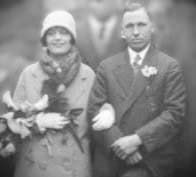
Robert Walter Parks and Gladys Mary Gamble married on April 6, 1926, in Hull, East Yorkshire of Reading, England. The ceremony occurred on a Tuesday, two days after Easter. The newlyweds had plans to live in the United States, which was very appealing to Gladys, but dreadful to her widowed mother.
Sarah Jane Gamble must have regretted ever being persuaded by her teenage daughters to permit them to go to the Hull docks unchaperoned to watch the ships arrive. Allowing the girls independence to observe ships and travelers was one thing, but dating the sailors from the ships involved personal risks.
At some point, Robert was more than a date to Gladys. She became his fiancée. Gladys’ young age, or the age difference of ten years, may have been a factor in Sarah’s dissapproval of their engagement, but Robert being an American, or “Yank,” was definitely troubling. The Gamble family was a closely knit group, born and raised in East Yorkshire county, and living in an overcrowded poor section of Hull. With Bill absent, killed in the World War, the children were everything to Sarah. If Gladys married Robert, and moved to the United States, Sarah feared she’d never see her daughter again.
It’s likely that Gladys was seventeen years old when she met Robert. She was eighteen when they married. If Gladys’ mother, Sarah, had really wanted to stop the impending marriage, she could have done so. In 1926, no marriage of a person under the age of twenty-one was valid without the consent of parents or guardians.
Robert arrived in Kingston upon Hull on April 2 or April 3, a few days before the planned wedding.1 He was the radio operator on the American cargo ship, SS Capulin, and could have easily kept in touch with Gladys, wiring her cablegrams as his ship approached England, letting her know the ship was on schedule. I can imagine Robert tapping a message via Morse Code from the Atlantic Ocean to Hull, it being either relayed through other vessels or being received directly at a coastal station. Then coastal station would have then sent a telegraph to the Hull post office where it was typed up as a standard paper telegram and hand-delivered to Robert’s fiancée.
As far as I know, the Gamble-Parks wedding was a civil affair, without a minister or priest leading the ceremony. Gladys’ mother, Sarah Jane Hodgson, was apparently raised a Catholic, and Gladys’ father, Thomas William Gamble, grew up in the Church of England.2 A record of Gladys and her siblings being baptized are found in the parish registers. When Robert’s father, Richard Borchart (also spelled Borchert), died in 1899, his burial service was held in the German Lutheran Church near Inman, Kansas). Robert’s adoptive parents, Henry and Lydia Hampton Parks, were married in Emporia, Kansas, in 1896 by a judge. Their daughter, Gladys Mae Parks, was married at her home in 1917, also in a civil ceremony by a judge.

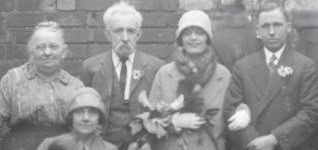
It’s unclear to me the exact location of the Hull wedding, but there’s an exceptional group photo showing Gladys and Robert, center stage, both decorated with flowers. Surrounding them are nineteen people, mostly the Gamble family and a few friends.
Gladys’ mother Sarah, and Sarah’s in-laws Thomas and Ann Elizabeth Pougher Gamble, are present. Ada and Dolly, two of Gladys’ sisters, and Cyril, a half-brother, complete the immediate family.3
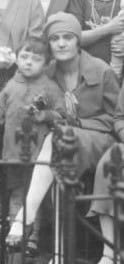
Some Gamble family members may have welcomed Robert, but it certainly wasn’t Gladys’ grandfather, Thomas Gamble. He was heard grumbling at the wedding, proclaiming loudly, “If our Bill was alive, she’d never marry a foreigner!” Even though Robert was a convenient target, hopefully he didn’t accept all the blame. After all, it took two to get married, and the family knew Gladys well. When she made up her mind to do something, she would not be deterred. That’s why members of her family described her as “headstrong.”
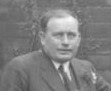
With Robert’s parents, Henry and Lydia Parks, back in Kansas, he appreciated the support of two shipmates during his marriage vows. Robert was especially pleased that Captain E. Henke, the master of the SS Capulin, and, Daniel Anderson, the ship’s chief engineer, attended the ceremony.4
It’s difficult to comprehend how surreal the wedding must have been to Gladys’ family. Their tears of joy had to be mixed with tears of uncertainty. Marriage to a foreigner living overseas was incomprehensible. Gladys would disappear, but not immediately, to another country and culture, far from Hull and far from England. Since Robert’s employment with the cargo line required him to complete the round-trip journey from New York City, any honeymoon trip together would need to be postponed until Gladys joined him in the United States.
Meanwhile, the Gamble family worried and asked one another, “Will we ever see Gladie again?”
*
Notes
1. Hull Evening News (Hull, Humberside, England), April 3, 1926, 6.
2. “Jacqueline Gamble Scott, Memories,” unpublished manuscript, 2000, 2. Note: “Grandmother Sarah came from a Catholic family, and Bill was oftentimes accosted on the streets by the Catholic priest, prophesying doom unless he changed his ways (drinkingwith his brothers.”
3. “Sometime later, Sarah had a male friend whom she did not wish to marry. He was the father of her youngest child, Cyril.” Jacqueline Gamble Scott, “Memories,” unpublished manuscript, 2000, 1. Cyril Gamble was born November 21, 1920, three years after the death of Thomas William “Bill” Gamble.
4. After a great deal of research, I’ve been unable to learn important details about SS Capulin‘s Captain E. Henke, including his first name, year and place of birth, and when he died. There was a career maritime officer and captain named Ernest Henke, son of Peter Henke, who was born in 1884 or 1885 in Libau, Russia, and immigrated to the United States in 1909. Ernest had a long career as master of ships—both civilian and military. It’s possible that Ernest was the Master of the Capulin in 1926 and attended the Parks wedding, but photographs of the two Henke captains—E. and Ernest—create doubt in my mind as to the two men being the same person. Ernest died in 1969.
*


Sounds like a happy occasion!